
Uncertainty-aware Prosthesis Control based on Bayesian Learning#
Minimised undesired prosthesis movements caused by environmental uncertainties. Achieved a 30% reduction in task completion time compared with conventional methods (statistically significant).
Developed the decision-making system involving biosignal processing (EMG and joint kinematics), motion control, and machine learning.
Built a dedicated experimental platform using Unity (C#) for VR simulation and data logging at up to 2 kHz, ESP32 for embedded sensor data acquisition and transmission firmware, and Python for online decision-making.
Published in IEEE Transactions on Neural Systems and Rehabilitation Engineering (IEEE TNSRE). [Paper] [VR Code] [Dataset]
Real-time Optimisation & Personalisation using Extremum Seeking Control#
Enables real-time adjustment of controller parameters for optimal performance. Reduced compensatory movements of trunk and shoulder (statistically significant).
Implemented Extremum Seeking Control and motion data acquisition firmware on SAMD21 and ESP32 microcontrollers using the Bosch BNO055 sensor on FreeRTOS and bare-metal platforms with DMA, I2C, SPI, ADC, and BLE communication interfaces.
Designed and manufactured the mechatronic prototype using 3D printing and laser cutting.
Collaborated with colleagues at Human Robotics Lab. Published in IEEE Robotics and Automation Letter (IEEE RA-L). [Paper] [Dataset]
Process-mining-based Framework for Human Intention Detection#
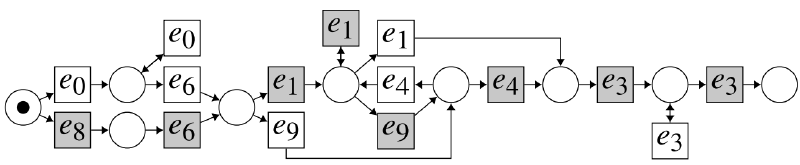
Developed a reasoning framework for human intention detection leveraging process-mining techniques and Petri nets.
- Example: A Petri net is extracted from EMG and motion data of a human subject reaching a single target, with actions \(e_i\) connected through state nodes (circles). The grey actions represent a specific type of movement event starting from the filled circle.
- Collaborated with colleagues at Process Science and Technology Research Group and Human Robotics Lab. Published in Information Systems and ICPM. [Paper] [Code]